


| My Rescue |
| Login to Remember your Favorite Animals and Breeds! |
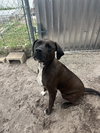
Won't you consider helping him get a new start?
Lucky was owner surrendered. He is heartworm positive. We use the slow kill method that is very effective.
LEASH MANNERS - Lucky walks ok on a leash but at times he will pull so he needs additional work with his leash walking.
SOCIALIZATION - He loves all people, even strangers and kids over the age of 8 and the vet. He does at times show anxiety toward some dogs. Lucky seems to prefer larger dogs over smaller dogs even though he did live with a Shitzu mix who he was fine with. He likes to chase squirrels so we feel he might not be good with cats, but we can cat test him if necessary.
ENERGY LEVEL AND EXERCISE - Lucky would go for a 2 mile run every other day or so and he loved it. He does run very fast, so when the doorbell rings hold onto him, he runs very very fast and will be hard to catch. The more exercise for him the better.
DAILY STRUCTURE AND SCHEDULE - Lucky was eating Authority dry food. He now will eat the dry food at the shelter which is ProPlan EN Vetinary Diet. You will a script from your vet. He goes out for walks after that. Since he is housetrained he can be left alone inside for several hours. Lucky does NOT chew or destroy anything. He eats his dinner at the shelter between 4 & 5 pm. In a home he did sleep with his owners. He will go into a crate and will whine some since he prefers out. Since he is heartworm positive he will need his heartworm tablet 1st of every month.
CONFIDENCE LEVEL - Lucky is very sweet and loves to give lots of kisses and lay in your lap. He gets nervous when kids are in the pool but will be fine when adults are in. Even though he does not like to get his nails clipped he will do it. Lucky loves all people even strangers and kids and the vet. With his previous owner he did great with neighbors children and his 8 year old but for whatever reason Lucky did not do well with his 6 year old.
OBEDIENCE TRAINING - Lucky's previous owners said they have worked with a trainer to help him with his anxiety with his younger child and he will need some work with his leash walking, not to pull.
PERSONALITY - He loves to sleep with his owner and lay in your lape while you watch tv or whatever you might be doing. He is also a big fan and very generous with giving out kisses. He loves car rides and would prefer to be up front with you rather then alone in the back.
IDEAL HOME: Lucky would be fine with or without another dog or children, of course we would dog test him with another dog if need be. Because of his love to run and go for walks a family that is somewhat active would be great. A fenced in backyard so he can run around and in. Older children would be fine. Also since he has poodle in him he possibly is hypoallgenic.
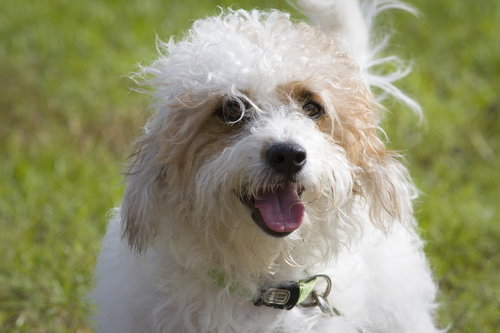
According to www.dogbreedinfo.com, although the Poodle has been known throughout Western Europe for at least 400 years, its origin is controversial. Whether it was developed in France, Germany, Denmark, or the ancient Piedmont is uncertain. Despite the claims of several other countries, France has now been officially recognized as its country of origin, and the breed occupies a special place in the affections of the French. It is certain that the Poodle is descended from a now nearly extinct French water dog, the Barbet and possibly the Hungarian Water Hound. The name "Poodle" probably derives from the German word "Pudel," which means one who plays in water. The Poodle was used as a gun dog and originally was used in Germany and France as a retriever of waterfowl. Hunters clipped the dog's thick coat to help him swim, leaving hair on the leg joints to protect them from extreme cold and sharp reeds. The French capitalized on the breed's high intelligence, trainability, and innate showmanship, and made the Poodle into a circus performer. His great popularity in that country led to the breed's common name "French Poodle." In France, however, the Poodle was called the "Caniche," or duck dog. The Poodle has been used to sniff out truffles lying underground in the woods. Poodles are depicted in 15th century paintings and in bas-reliefs from the 1st century. Toy Poodles became royal favorites, particularly in the 18th century. The Toy and Miniature Poodle varieties were bred down from larger dogs, today known as Standard Poodles. The three sizes are considered one breed and are judged by the same standard. Today, the Poodle is primarily a companion and show dog, though he can learn almost anything. Some of the Miniature Poodle's talents include: retrieving, agility, watchdogging, competitive obedience, and performing tricks. The Miniature Poodle is a cheerful, super smart, sensitive and highly trainable companion dog. The breed is great at learning tricks, and a favorite in the circus ring. The Poodle will feel slighted if it is left out of family activities. He is very amusing and clever. Many owners feel this dog understands speech in an uncanny way. Some love to play with children, but some are sensitive and nervous. They can be somewhat high-strung. Be careful where you buy your puppy. Purchase from parents you have met and liked, and even ask to see the grandparents if possible. They tend to be quite reserved with strangers and should be socialized as a puppy. Any effort the owner puts into training and socializing will be well rewarded. This is a very good watchdog for its size, seldom becoming aggressive. They do tend to bark a lot. Poodles are friendly with other dogs and non-canine pets. They have a life-expectancy of 12-15 years.
Other Pictures of Lucky (click to see larger version):
;) 158.9k |
;) 275.8k |
;) 194.5k |


Copyright © Pet Rescue by Judy