


| My Rescue |
| Login to Remember your Favorite Animals and Breeds! |
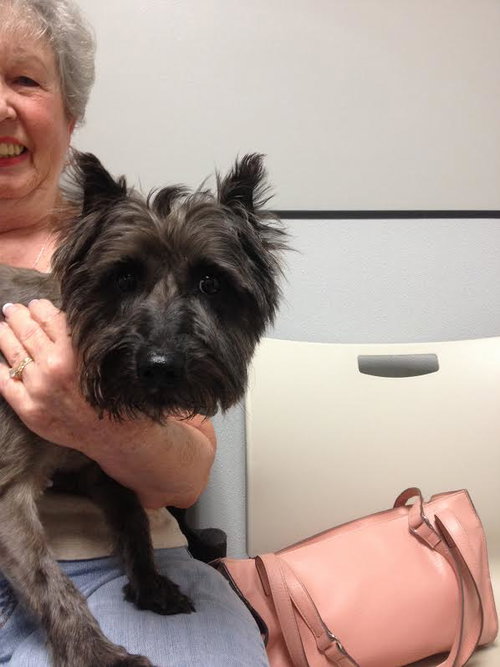
This beautiful dog came to us as a stray. Cody is very calm and sweet! He walks well on his leash. He will make a great addition to anyone's home.
According to www.dogbreedinfo.com, the Scottish Terrier was developed in Scotland in 1700, but the dog with the size and shape we know today dates from 1890. The breed was first called the Aberdeen Terrier, after the Scottish town of the same name. Like many other long-low breeds, the Scottie was used to hunt den animals, particularly otter, fox, badger and rabbit. Today this stylish breed is primarily a companion, though he still retains his hunting instincts.
Brave and alert, the Scottie is hardy and lovable. They are charming and full of character. Playful and friendly as a puppy, he matures into a dignified adult. The Scottish Terrier makes a very good watchdog. It is inclined to be stubborn, however, and needs firm, but gentle handling from an early age or it will dominate the household. Socialize well. This breed is sensitive to correction, therefore if you are firm and confident, the dog should respond to you. However, if you do not mean it when you tell him, "No" he will know it, and will not listen. Obedience training must be consistent but persuasive. Never hit a dog and do not play aggressive games with a terrier such as the Scottie, like wrestling and tug-of-war. He can challenge family members who have not established leadership over him. Lively, proud, and intelligent, it has a reliable temperament. Likes to dig, enjoys walks, loves to play ball games, and is thoroughly sporty, home loving and independent. It has been described as the dog that can go anywhere and do anything - a big dog in a small dog's body. It is very sensitive to criticism and praise and therefore should be trained gently. These dogs make good house pets. Do not allow this dog to developed Small Dog Syndrome, human induced behaviors where the dog believes he is pack leader to humans. This will cause varying degrees of behavior issues including, but not limited to, moody, snappish, stubborn, protectiveness and obsessive barking. These are not Scottie traits, but traits brought on by the way the human treats the dog. Children need to be taught how to display leadership over the dog or the dog will not be good with them. They are usually not recommended for homes with younger children simply because most owners do not display enough authority over them, and the dogs take over the home. All of the negative behaviors can be reversed if the human changes the way they deal with the dog. The dog needs to clearly know the rules of the home. They need all members of the family to be firm, confident, and consistent in their approach. The dogs need to be provided with a daily pack walk to reinforce leadership and burn both mental and physical energy.
This dog is good for apartment living. It is moderately active indoors and will do okay without a yard. Prefers cool climates. Regular brushing of the harsh wiry coat is important and extra care should be taken when the dog is shedding. Bathe or dry shampoo as necessary. The dog should be professionally trimmed twice a year. The hair on the body is left long, like a skirt, while the hair on the face is lightly trimmed and brushed forward. This breed sheds little to no hair. Scottish Terriers have a life expectancy of about 12-15 years.
According to www.dogbreedinfo.com, the Miniature Schnauzer is reportedly a result of crosses between the Standard Schnauzer, the Affenpinscher and perhaps the Poodle. He is originally a German breed, named after the German word for muzzle, "Schnauze." The Miniature Schnauzer excels at killing rats, but today it is mostly a popular and esteemed companion. Some of the Schnauzer's talents include: hunting, tracking, watchdogging, competitive obedience, and performing tricks. Very perky and bright-eyed. Loving and intelligent. Energetic, affectionate, and obedient. Playful, happy and alert, they like children. The Miniature Schnauzer enjoys time and companionship from its owner. Without the proper leadership, it can be feisty and fairly dog-aggressive - putting on a show of superiority without necessarily intending to fight. This can be fairly dangerous for the Miniature Schnauzer, who will challenge even large dogs, sometimes bringing more trouble on himself than he really wanted. Socialize this breed well with other dogs when it is still a puppy. If properly introduced, and if the dog does not see himself as pack leader, the Miniature Schnauzer will get along with another dog. They make good companions and family pets. Schnauzers tend to bark a lot, but it does not have a yappy bark it sounds like a low carried-out voice, howl of a voice. They make good guard dogs and mouse catchers. They are excellent watchdogs and are great to travel with. Some can be reserved with strangers, but most love everyone. Socialize well. Do not allow this little dog to developed Small Dog Syndrome, a human induced behavior where the dog feels he is pack leader to humans. This can cause a varying degree of behavior problems, including, but not limited to separation anxiety, willful, nervous, barky, guarding, bold and sometimes temperamental, not hesitating to attack much bigger dogs. A mentally stable dog, who gets enough mental and physical exercise will have a totally different personality. These are not Miniature Schnauzer traits, but rather behaviors brought on by the way the dog is treated by the people around him. It is all up to the humans. As soon as the humans start being true pack leaders, the dogs behavior will change for the better.


Copyright © Pet Rescue by Judy