Welcome to Pet Rescue By Judy!
401 South Laurel Avenue
Sanford, FL 32771
(407) 302-4497
info@petrescuebyjudy.com


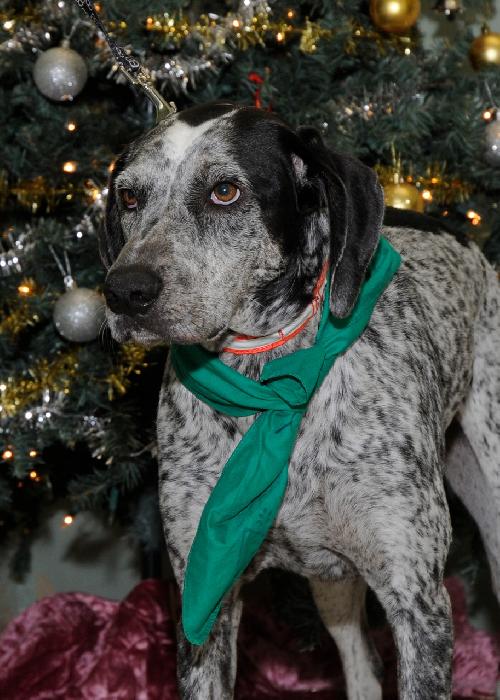
Dyson the Pointer's Web Page

| My Rescue |
| Login to Remember your Favorite Animals and Breeds! |
Dyson the Pointer needs a caretaker or foster!
Won't you consider helping him get a new start?
Won't you consider helping him get a new start?
Name: Dyson the Pointer
Status: Adopted!
Adoption Fee: $250
Species: Dog
Breed: Pointer / Mixed (short coat)
Learn more about the Pointer.Color: White and Brown
Sex: Male (neutered)
Current Size: 55 Pounds
General Potential Size: Medium
Current Age: 17 Years 10 Months (best estimate)
Activity Level: Moderately Active
Indoor or Outdoor: Indoor Only
Good with Dogs: Yes
Good with Cats: No
Good with Kids: Yes
Housetrained: Yes
Microchipped: Yes
Dyson the Pointer's mother, Carmella the Pointer (adopted) can also be seen on our website.
Dyson the Pointer's brother, Twizzler the Puppy (adopted) can also be seen on our website.
Dyson the Pointer's brother, Twizzler the Puppy (adopted) can also be seen on our website.
Description:
Dyson is just an all around good boy. Here are some points of interest about him:
*100% housetrained- NO accidents
*Doesn't jump up on people
*No aggression- food or otherwise
*Great wih kids
*Will bark when someone comes to the door or when he is excited, but he is not a "barker"
*Doesn't try to chew anything other than bones
*Comes when called- listens and responds
*Pulls some on the leash, but responds quickly when corrected
*Sleeps all night- only gets up when everyone else gets up
Dyson was adopted from us some 2 years ago and returned recently because of his high prey drive. Dyson is not good with cats.
Foster update 12/11: Dyson obviously has a problem with cats (per his previous owners), but I am not finding that his obsessed with squirrels or birds- he really pays no attention to them. I also would not say he is a high energy dog. He is actually very laid back around the house. He does like to go for walks and play with my dog, but he is also very content to just hang out and relax! I would say he is more of a moderately active dog.
I took him to the dog park where there was a dog fair going on. With all the activity (people and dogs everywhere), he was great! He even laid next to me when I sat down. He also got to play off leash- he really enjoyed running around free. There were dogs of all sizes in there and he had no problems at all with any of them. It was so much fun to watch him- he was so happy. Every once in a while he would stop and look around to make sure I was still there, then he would go right back to running.
Dyson is just an all around good boy. Here are some points of interest about him:
*100% housetrained- NO accidents
*Doesn't jump up on people
*No aggression- food or otherwise
*Great wih kids
*Will bark when someone comes to the door or when he is excited, but he is not a "barker"
*Doesn't try to chew anything other than bones
*Comes when called- listens and responds
*Pulls some on the leash, but responds quickly when corrected
*Sleeps all night- only gets up when everyone else gets up
We rescued him and his family from a kill shelter in Georgia orginally.
According to www.dogbreedinfo.com, according to the most credible hypothesis, the Pointer was developed two centuries ago by crossing among the Italian Pointer, the Foxhound, the Bloodhound, the Greyhound, the Newfoundland, the Setter, and the Bulldog. This is an almost unbelievable mix, but it certainly has produced an outstanding result. The modern Pointer has existed for about eighty years. The Pointer is named for the motionless stance the dog assumes once he has found game. The direction of the point tells the hunter where the game is hiding. The first recorded mentions of the Pointer in England date from around 1650, when the Pointer was used to find hare for the Greyhound to hunt. By the early 1700's the Pointer became the dog of choice. The Pointer is renowned for his scenting prowess. He works very quickly, covering a lot of ground. The Pointer is particularly good on upland birds, but adapts well to other game. The breed has excellent endurance in warm weather, but is not suited to very cold conditions. Working best on land he is not very comfortable in water. He has a legendary tracking and pointing skills, but is not usually expected to retrieve game.
The English Pointer is full of energy and go-power. Loyal and devoted he is a true friend. Kind and patient with children, he is a dashing gentleman. The Pointer is affectionate, intelligent and clean. An energetic and enthusiastic hunter, yet calm at home. Wise and adaptable to every situation. Socialize well at an early age to combat a tendency for timidity. Some can be high-strung. They tend to be a bit willful, distractible and reserved with strangers. It will bark at suspicious noises, but it is not a watchdog. Show lines tend to produce better pets. Field lines are often too active and hunt-oriented to make good pets. Hunting instincts develop early. Puppies, even at eight weeks old, often display pointing behavior. These fairly independent dogs are generally good with other pets and are not usually dog-aggressive. They have a life expectancy of 13-14 years.
The English Pointer is full of energy and go-power. Loyal and devoted he is a true friend. Kind and patient with children, he is a dashing gentleman. The Pointer is affectionate, intelligent and clean. An energetic and enthusiastic hunter, yet calm at home. Wise and adaptable to every situation. Socialize well at an early age to combat a tendency for timidity. Some can be high-strung. They tend to be a bit willful, distractible and reserved with strangers. It will bark at suspicious noises, but it is not a watchdog. Show lines tend to produce better pets. Field lines are often too active and hunt-oriented to make good pets. Hunting instincts develop early. Puppies, even at eight weeks old, often display pointing behavior. These fairly independent dogs are generally good with other pets and are not usually dog-aggressive. They have a life expectancy of 13-14 years.
Other Pictures of Dyson the Pointer (click to see larger version):
;) 31.9k |
;) 43.5k |
;) 46k |
;) 59.4k |
;) 52.3k |
;) 54k |
;) 27.4k |
;) 34.2k |
;) 24k |
;) 23.6k |
;) 31.3k |
;) 19.7k |
;) 16.8k |
;) 25.4k |
;) 28.6k |
;) 39.5k |
;) 103.2k |
;) 42.9k |
;) 45.1k |
;) 101.1k |
;) 40.2k |


Copyright © Pet Rescue by Judy