


| My Rescue |
| Login to Remember your Favorite Animals and Breeds! |
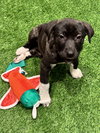
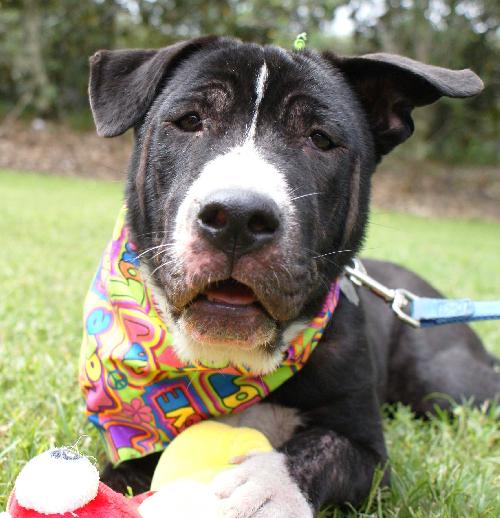
Tiger Lily was brought to us by a local police officer. He saw this sweet puppy in the ownership of a homeless man whom was unable to care for her. Tiger Lily has some puppy mange but it has shown significant improvement in the short time she's been with us.
Tiger Lily was fortunate enough to participate in the University of Doglando kid's camp for two weeks. She learned how to walk on a leash, Sit and Stay, participated in agility sports, learned how to jump and swim in a pool, as well as proper behavior in public areas.
Foster Update: Tiger Lilly is doing great. Her Demodex mange is under control, and her coat is filling in quite nicely. She eats 1 1/2 cups of Origins at 8:00 am, which is followed by her Demodex perscription. At 5:00, she eats another 1 1/2 cup of Origins, and takes her vitamin. Since her diet is important to recovering from the mange, I have been using plain chicken as training treats. Her noise anxiety seems to be diminishing quickly, and her confidence and personality are blooming. She is still a bit hesitant when meeting strangers, but with a slow introduction, she quickly warms up to everyone she meets. She is remarkably intelligent, and training with her is a breeze as she really wants to please. She continues to improve on her sit, stay, down, wait, and shake commands. She is still definitely a chewing puppy, and we continue to work on learning what items are approporiate to chew and which ones are not. She needs supervision when not in her crate. She is going to make a WONDERFUL addition to someone's home.
- Leash Manners Walks well on leash with basic collar and leash
- Crate/House Training Spends time alone in crate, sleeps on dog bed. Is a bit reluctant to enter crate, but once in it is quite content.
- Socialization Good with people of all ages/genders/races, good with kids. She is great with other dogs, and is a favorite of many at her fosters local dog park
- Energy Level and Exercise Relatively High - in addition to daily walks, she is visiting an off leash dog park several times a week, where she can't sprint with other dogs, and fetch a tennis ball in the lake.
- Daily Structure and Schedule She is currently eating Orijen fish-based kibble twice daily. Training treats are high protein, low grain as grain based treats aggravate skin irritation.
- Special needs she is recovering extremely well from her puppy mange, and has grown a very nice coat. She is on a daily oral medication, ivermectin, to keep her puppy mange under control. Once a week, she gets a bath with a medicated shampoo.
- Confidence Level she has overcome her nervous responses to sounds and new environments, and has developed a good sense of confidence
- Obedience Training a very smart, eager to please, easily trainable dog. She knows sit, down, shake, leave it, and stay.
- Behaviors she still has issues with chewing, and needs close supervision. Her chewing is typically a sign that she needs to get out for a bit more exercise. She still struggles with jumping when excited or greeted by a familiar person.
- Personality Quirks she is very cuddly, and appreciates a belly rub whenever offered. She is very expressive with her wrinkled eyebrows, and will gently tap you with a paw to let you know that she needs or wants something.
- Ideal Home she will easily adjust to most homes provided she is given a good combination of petting and cuddling and a safe place for her to sprint and run off her puppy energy
According to www.dogbreedinfo.com, early Bulldogs were used in the bloody sport of bull bating. Some of these dogs emigrated with their masters from England to America. Eventually the English Bulldog was bred down in size and his personality was softened, but the American version remained a larger, fiercer dog. The American version has longer legs and more speed and agility than the English show dog. Thanks to the efforts of John D. Johnson of Summerville, Georgia the American Bulldog exists today. After he returned from WW II he was disappointed to find that, like the English Mastiff, they were almost completely extinct. He then decided to gather the best he could find from all across the rural south and bring them back from the brink of extinction. He has been breeding these dogs longer than anyone else in the world and his father bred them before him. He is an old man now (in his 80's) and these dogs have always existed in his family. He is the sole reason why they exist today. If it were not for his efforts they surely would be gone. He has been breeding them non-stop since then. The American Bulldog has also been used as a guard and in hunting bear, wild boar, squirrel and raccoon. They have even been trained to drive cattle and guard stock from predators. Farmers prize these dogs for their stamina, protectiveness, intelligence and working abilities. Some of the American Bulldogs talents are hunting, watchdogging, tracking, weight pulling, and guarding. An American Bulldog should never be confused with uniquely different breeds such as the American Staffordshire Terrier or the American Pit Bull Terrier. The American Bulldog is a brave and determined, but not hostile dog. Alert and self-confident, this breed genuinely loves children. It is known for its acts of heroism towards its master. These dogs have fought wild dogs, bulls and even fire. It is said "fighting off one of these dogs is like fighting an animal that possesses an alligator's head and a python's body." Yet when called off by their handler, they immediately obey. No wonder they are said to have "true grit, true devotion and true love." Because of its strong protective instincts, the American Bulldog should be well-socialized and obedience trained at an early age. Some may be aggressive with other dogs and reserved with strangers. They need to be around people to be truly happy. This breed tends to drool and slobber. They have a life expectancy of up to 16 years.
Other Pictures of Tiger Lilly the Smart Puppy (click to see larger version):
;) 83.8k |
;) 34.1k |
;) 26.2k |
;) 25.2k |
;) 54.1k |
;) 65.3k |
;) 45.4k |
;) 58.7k |
;) 53.4k |
;) 42.2k |
;) 22.1k |
;) 26.9k |
;) 37.6k |


Copyright © Pet Rescue by Judy