



| My Rescue |
| Login to Remember your Favorite Animals and Breeds! |
Learn more about the Jack Russell Terrier.
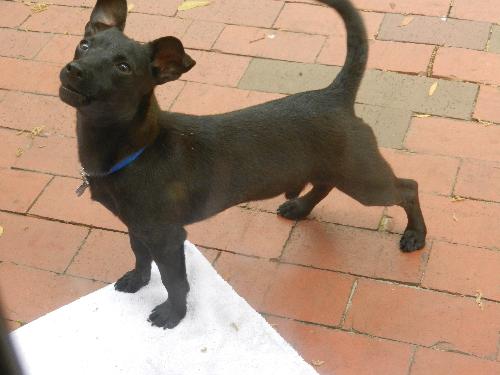
Kuma appears to have Dachsund in him because of his long body, and the vet believes also some Jack Russel Terrier. I personally see some min pin in him too because of the ears, but who knows. He is very sturdy and yet cuddly for his body frame. So whatever, he is going to be a small sweet guy. Our vet also thinks he ia about 8 months old, and will not grow much more, so we are expecting somewhere around no more than 14 pounds...!! He is very quiet for his size, barely whimpering when itis time to go to sleep in his crate. He has not any accidents in his crate since we have had him, nor in the house when he sleeps on the bed with my duaghter, so I am guessing he is most likely housebroken. He likes to ride in the car and sat in my back seat like a good little boy all day while running errands, never jumping on me or trying to crawl in the front. He was like a polite little young man when it comes to his manners, but really does love to play like a little puppy. He is really the best of all worlds if you want a young pup, but a tiny dog.
He loves small dogs and is a little frightened of my Bull Mastiff, but if I was 10 pounds I would be afraid of a bull mastiff, too!
According to www.dogbreedinfo.com, bred down in size from pit-fighting dogs of the bull and terrier types, the Boston Terrier originally weighed up to 44 pounds (20 kg.) (Olde Boston Bulldogge). It is difficult to believe that these dapper little dogs were once tough pit-fighters. In fact, their weight classifications were once divided as lightweight, middle and heavyweight. The Boston Terrier is one of the few breeds that was "Made in the USA." Boston to be exact. The original Boston Terriers were a cross between the English Bulldog and now extinct English White Terrier. Around 1865, the coachmen employed by the wealthy people of Boston began to interbreed some of these fine dogs owned by their employers. One of these crosses, between an English White Terrier and an English Bulldog resulted in a dog named Hooper's Judge. Judge weighed over 30 pounds (13.5 kg.) he was bred down in size with a smaller female and one of those male pups was bred to yet a smaller female. Their offspring interbred with one or more French Bulldogs, providing the foundation for the Boston Terrier. By 1889 the breed had become sufficiently popular in Boston that fanciers formed the American Bull Terrier Club, but this proposed name for the breed was not well received by the Bull Terrier Fanciers. The breeds nickname, roundheads, was similarly inappropriate. Shortly after, the breed was named the Boston Terrier after its birthplace. The breed was recognized by the AKC in 1893. It was first shown in Boston in 1870. In the early years the color and markings were not very important but by the 1900's the breeds distinctive markings and color were written into the standard becoming an essential feature. Terrier only in name, the Boston Terrier has lost most of their ruthless desire for mayhem, preferring the company of humans, although "some" males will still challenge other dogs if they feel their territory is being invaded. Though bred at first for use in dog fights, today's Boston Terrier has been bred to have less aggressive tendencies. It is gentle, alert, very intelligent, and well-mannered. Enthusiastic and occasionally rambunctious, this breed has a sense of humor. They are very sensitive to the tone of one's voice. This breed likes to learn and therefore is not difficult to train. Their intelligence ensures they pick things up quickly. At times they can be somewhat willful. Some owners have reported that their dogs are good watchdogs barking only when necessary, while other owners have reported their female Boston Terriers do not bark at the door at all. Most reliable with children, especially good with elderly people and very friendly with strangers. The Boston Terrier is playful, very affectionate and likes to be part of the family. Very popular in the United States, due above all to its excellent character. They generally get along well with non-canine pets. Some males are dominant and may fight with other dogs. These little dogs may be difficult to housebreak. They have a life expectancy of 15 or more years.
Other Pictures of Kuma the Dachshund Mix (click to see larger version):
;) 63.3k |
;) 72.4k |
;) 62.1k |


Copyright © Pet Rescue by Judy