



| My Rescue |
| Login to Remember your Favorite Animals and Breeds! |
Won't you consider helping her get a new start?
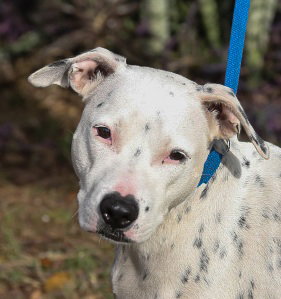
Suki (now Molly) came to us originally from Animal Control. She was adopted but had to come back recently. It seems that some of the neighbors didn't really understand the breed. A Dalmatian can get protective of its human family; in addition, they can be nervous around strangers. Molly's owner did not want to risk any incidents, so she brought her back here.
Molly is initially shy around strangers, which is typical of the breed. For some strange reason, she is extremely fearful of older men. She is great with women of all ages, and children. She was in a home with three children, so she is used to them. She is housebroken, and crate trained--although she'd much rather sleep in the bed with you! The crate is her safe space, because she runs free in the house. A fenced in yard is a MUST. She loves having room to run around!
According to www.dogbreedinfo.com, Dalmatians were bred to run under or along-side of horse-drawn carriages and therefore have an vast about of stamina and energy. They do not like to just sit around all day with nothing to do. They are playful, happy-go-lucky, extremely sensitive and loyal. The Dalmatian needs human companionship, without which it is likely to become depressed. For this reason they do not make good yard dogs. They have excellent memories and can remember for years any bad treatment it has had. The Dalmatian enjoys playing with children, but may be too rambunctious for toddlers. They get along well with other pets, but some may be aggressive with strange dogs; males often dislike other males. Somewhat high-strung, and can be timid without enough socialization. Quite intelligent, but can be willful. Generally does well with firm, consistent training. The Dalmatian is trainable to a high degree of obedience. They can be trained for defense and are good watchdogs. Dalmatians often have large litters, sometimes up to 15 pups. Some can be aggressive if not properly raised. Fifty percent of people who adopt a Dalmatian puppy do not keep them past the first year. Young Dalmatians are very energetic, however they do calm down after a few years and people who keep them long enough to get past their active stage tend to be very pleased. If you are thinking about adopting a Dalmatian puppy be sure you have the time and energy for them. If you are a very active person with room for the dog to run, a Dalmatian may be right for you. There is total disagreement about the origin of this breed. Traces of it are found in Egyptian bas-reliefs and Hellenic friezes, so it certainly is an ancient breed. In 1700 a dog known as the Bengal pointer, similar to the Dalmatian, existed in England, calling into question the Dalmatians Yugoslavian origin. Some claim the Dalmatian is a Croatian breed. Efforts to have it recognized as an indigenous Croatian breed had been aggravated by this state of affairs, at least up until 1993, when the FCI did finally recognize the Croatian roots of the Dalmatian dog, although they continue to deny Croatia standard patronage rights over the breed. In the Middle Ages it was used as a hound. The breed became popular as a carriage dog in the 1800's. They trotted beside (and even among) the horses and then guarded the carriages and horses while the master was occupied elsewhere. It followed its master with exceptional reliability and hardiness, whether its master was on foot, on horseback, or in a carriage. The versatile Dalmatian has seen many uses, before and since, as a mascot for firemen, war sentinel, circus performer, vermin hunter, hound, shepherd and guard dog. Today, this beautiful breed is primarily a companion dog. They have a life expectancy of 10-12 years.
Video of Molly (Suki) the Dalmatian Terrier~Video:

Other Pictures of Molly (Suki) the Dalmatian Terrier~Video (click to see larger version):
;) 64.9k |
;) 59.4k |
;) 24.2k |
;) 71.3k |
;) 22.2k |
;) 22.3k |
;) 25.5k |
;) 37.1k |
;) 61.3k |


Copyright © Pet Rescue by Judy