


| My Rescue |
| Login to Remember your Favorite Animals and Breeds! |
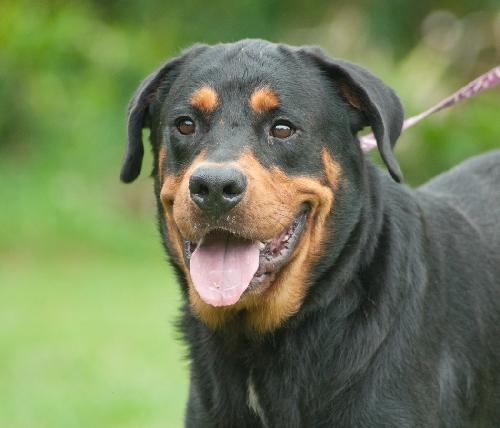
Kenzington came to us from a local animal control, where the staff was rooting for him to get a home. His time had come up, and we were happy to take him!
Foster Update: Kenzington is a laid back guy who spends a lot of time sleeping. We call him “Kenzi” and he responds to this name as well. He has become much of a house dog. I think the medication for the seizures sedates him. He is really sweet. He likes to be petted and be made over. He gives you his paw and will come to you to pet him and he will lick your hand. He is not aggressive. Occasionally he will growl at the other dogs and you only have to tell him no and he stops. Kenzi will go to the door or come to you if he needs to go outside to do his business. I put him out every 4-5 hrs as well. He needs to be put out before bed as well. He will come into our room and walk around if he needs to go outside. He is fed twice a day. He weighs 102 lbs and so I have decreased is food amount to 1 cup twice a day. He can be very difficult to get in a car. He will not jump in or out. I put his legs up on the seat and then lift him up and then slowly pull him until he jumps out. He seems to be afraid of jumping. Patience is very important in dealing with Kenzi. He will not jump up on you. When he goes out into the yard, he walks around and enjoys being out there for awhile. Kenzington does have a high prey drive and does not do well around small dogs, puppies or cats.
Medical Info: Kenington has epilepsy and takes regular medication. The Phenobarbital and Potassium Bromide levels are at therapeutic levels. The medication doses and frequency is:
- Phenobarbital is 2 tablets 2 times a day, spaced at 12 hours intervals. 6am-6pm.
- Potassium Bromide is I capsule daily given with morning meds.
- Thyroid med 1 pill twice a day spaced at 12 hr interval
He still has breakthrough seizures occasionally. The last one was Aug 3. This is really great as he usually has more than one in a 2 day period. The seizures are called grand mal and includes sever spasms of his whole body. They are awful to watch. You have to leave him alone while having the seizure. He will be incontinent of urine. It will last 1-2 minutes. He will eventually get himself up and walk around the house. At first he will bump into things because he is not aware of his surroundings. When he is aware of his surrounding he will come to you. He is okay then. If you touch him before he is aware of you, he may bite you or snap at you. For this reason, he would not do well in a home with small children.
Like many dogs in the South, Kenzington is heartworm positive, but don't let that stop you from adopting a great dog. We are treating him with monthly heartworm preventative, our preferred method. Many heartworm positive dogs go on to lead long and healthy lives.
PRBJ treats ALL of our dogs with monthly Heartworm preventative. Heartworms are transmitted to dogs via mosquitoes. Humans do not contract heartworms. Heartworm positive (HW+ ) dogs are treated with the recommended slow kill method, using monthly HW preventative as it is gentler on the animal’s system than the more invasive injection method. Most dogs that are Heartworm positive can lead healthy, normal lives if the worms are caught early and treatment began. There are different options to treat HW and new owners may choose to redirect their type of treatment with direction of their vet. All HW+ dogs have a HW slow treatment info sheet in their adoption folder which will be provided to new owners.
*** Are you familiar with Rottweilers? According to www.dogbreedinfo.com, the Rottie is calm, trainable, courageous, and devoted to their owner and family. The Rottweiler is probably descended from the Italian Mastiff. During the Middle Ages, it was bred in the German town of Rottweil for use as a cattle dog. Practically extinct in the 1800's, the breed population began a comeback in the early twentieth century due to the efforts of enthusiastic breeders centered in Stuttgart. Some of the Rottweilers talents include: tracking, herding, watchdogging, guarding, police work, carting, competitive obedience, and schutzhund. They have a reliable temperament, but they require owners who can handle their massive size. The Rottie is a natural guard dog with a mellow temperament with their family, but will protect them fiercely, which may be part of the reason they get a "bad rap." Known people are enthusiastically welcomed; strangers get no farther than the sidewalk. They are highly intelligent and have proven their worth beyond question in police, military, and customs work over many centuries. This breed needs a lot of companionship and socialization to be truly happy. They can be aggressive with other dogs and should be kept on leashes in public places. They have a life expectancy of 10-12 years.
Other Pictures of Kenzington the Friendly Rottie (click to see larger version):
;) 26.6k |
;) 41.2k |
;) 27.7k |
;) 31k |
;) 27.5k |
;) 22.6k |
;) 19.2k |
;) 20.2k |
;) 19.8k |
;) 19.7k |
;) 18.6k |


Copyright © Pet Rescue by Judy