Welcome to Pet Rescue By Judy!
401 South Laurel Avenue
Sanford, FL 32771
(407) 302-4497
info@petrescuebyjudy.com


Siam the Harliquin's Web Page

| My Rescue |
| Login to Remember your Favorite Animals and Breeds! |
Siam the Harliquin needs a caretaker or foster!
Won't you consider helping her get a new start?
Won't you consider helping her get a new start?
Name: Siam the Harliquin
Status: Adopted!
Adoption Fee: $125
Species: Cat
Breed: Turkish Van / Mixed (short coat)
Color: White
Sex: Female (spayed)
Current Size: 9 Pounds
General Potential Size: Medium
Current Age: 20 Years 3 Months (best estimate)
Activity Level: Moderately Active
Indoor or Outdoor: Indoor Only
Good with Dogs: Yes
Good with Cats: Yes
Good with Kids: Yes
Declawed: No
Housetrained: Yes
Microchipped: Yes
Special Needs: Not only is Siam a very special kitty but she is a special kitty with some special needs: she is allergic to cat foods that are high in grain content. Siam wants us to make certain that her new family is fully aware of this fact and are willing to make certain high grain foods remains removed from her diet. When entering into her current foster home, Siam was experiencing on-going skin eruptions full blown with itching and irritation. But, as soon as she went to a low grain food her skin cleared up drastically and her itching has now stopped. The result = a very happy healthy cat with a full and beautiful coat now.
Description:
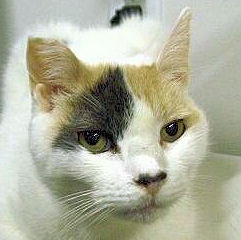
Siam is a white cat with some of the coolest markings on her head. She has these kinda pie-shaped orange and gray spots that looks like she slipped her Mardi Gras mask up off her eyes. What a sweetie!
UPDATE: Here is a wonderful update on our sweet Siam from her foster mom:
Siam is the NICEST cat. I brought her home and she was calm and friendly to my own cats right away-she is friendly and non-aggresive to other cats and does really well with my dogs also. She loves to sit on the edge of the bathtub when I am taking a bath and "talk" to me. She talks a little but it is not constant and it is so cute!! I REALLY want this wonderful cat to find a loving wonderful home as she is about 3 yrs old and has never had a home to call her own. Did I mention all you have to do is look at her and she starts to purr!!!"
Not only is Siam a very special kitty but she is a special kitty with some special needs: she is allergic to cat foods that are high in grain content. Siam wants us to make certain that her new family is fully aware of this fact and are willing to make certain high grain foods remains removed from her diet. When entering into her current foster home, Siam was experiencing on-going skin eruptions full blown with itching and irritation. But, as soon as she went to a low grain food her skin cleared up drastically and her itching has now stopped. The result = a very happy healthy cat with a full and beautiful coat now.
And, yes, I know the video is on its side. Just tilt your head as you watch it.....
According to The Cat Fanciers Association, the cat known in the United States as the Turkish Van is a rare and ancient breed that developed in central and southwest Asia, which today encompasses the countries of Iran, Iraq, southwest Soviet Union and eastern Turkey. “Van” is a common term in the region that has been given to a number of towns, villages and even a lake - Lake Van - so it is no surprise that the uniquely patterned cat native to the region was named the “Vancat” by the residents. They were first brought to England in 1955 as the Turkish cats, but this was later changed to Turkish Van to avoid confusion with the Turkish Angora. Although the breed has an ancient lineage, the Turkish Van is a relative newcomer to the United States, arriving in 1982. They are considered regional treasures in their homeland, and are not readily available for export to other countries. Even in areas where the breed has been known for centuries, they are still relatively rare.
The breed was first brought into Europe from the Middle East by returning crusaders, and has been known by a variety of names over the centuries such as the white ringtail and the Russian longhair. A common misconception is that the Turkish Van is simply a color variation of the better known Turkish Angora. In reality, the Van and the Angora are distinct breeds that developed in geographically distant regions of Turkey. When seen together, the differences in type, size, boning and coat are readily apparent.
The coloration of the Turkish Van, which is considered by many to be the original breed to carry the piebald gene, calls for a white, semi-longhaired cat with colored markings restricted primarily to the head and tail. Other piebald cats that have been selectively bred for many generations to achieve similar markings are said to be “van-patterned” after the breed that originally sported it. The coat lacks an undercoat and has a very unique cashmere-like texture that makes it water-resistant. This brings us to another interesting feature of this breed - they love water and in their native region they have been termed “the Swimming Cats.”
The Turkish Van takes three to five years to reach full maturity and is a large
Siam is a white cat with some of the coolest markings on her head. She has these kinda pie-shaped orange and gray spots that looks like she slipped her Mardi Gras mask up off her eyes. What a sweetie!
UPDATE: Here is a wonderful update on our sweet Siam from her foster mom:
Siam is the NICEST cat. I brought her home and she was calm and friendly to my own cats right away-she is friendly and non-aggresive to other cats and does really well with my dogs also. She loves to sit on the edge of the bathtub when I am taking a bath and "talk" to me. She talks a little but it is not constant and it is so cute!! I REALLY want this wonderful cat to find a loving wonderful home as she is about 3 yrs old and has never had a home to call her own. Did I mention all you have to do is look at her and she starts to purr!!!"
Not only is Siam a very special kitty but she is a special kitty with some special needs: she is allergic to cat foods that are high in grain content. Siam wants us to make certain that her new family is fully aware of this fact and are willing to make certain high grain foods remains removed from her diet. When entering into her current foster home, Siam was experiencing on-going skin eruptions full blown with itching and irritation. But, as soon as she went to a low grain food her skin cleared up drastically and her itching has now stopped. The result = a very happy healthy cat with a full and beautiful coat now.
And, yes, I know the video is on its side. Just tilt your head as you watch it.....
According to The Cat Fanciers Association, the cat known in the United States as the Turkish Van is a rare and ancient breed that developed in central and southwest Asia, which today encompasses the countries of Iran, Iraq, southwest Soviet Union and eastern Turkey. “Van” is a common term in the region that has been given to a number of towns, villages and even a lake - Lake Van - so it is no surprise that the uniquely patterned cat native to the region was named the “Vancat” by the residents. They were first brought to England in 1955 as the Turkish cats, but this was later changed to Turkish Van to avoid confusion with the Turkish Angora. Although the breed has an ancient lineage, the Turkish Van is a relative newcomer to the United States, arriving in 1982. They are considered regional treasures in their homeland, and are not readily available for export to other countries. Even in areas where the breed has been known for centuries, they are still relatively rare.
The breed was first brought into Europe from the Middle East by returning crusaders, and has been known by a variety of names over the centuries such as the white ringtail and the Russian longhair. A common misconception is that the Turkish Van is simply a color variation of the better known Turkish Angora. In reality, the Van and the Angora are distinct breeds that developed in geographically distant regions of Turkey. When seen together, the differences in type, size, boning and coat are readily apparent.
The coloration of the Turkish Van, which is considered by many to be the original breed to carry the piebald gene, calls for a white, semi-longhaired cat with colored markings restricted primarily to the head and tail. Other piebald cats that have been selectively bred for many generations to achieve similar markings are said to be “van-patterned” after the breed that originally sported it. The coat lacks an undercoat and has a very unique cashmere-like texture that makes it water-resistant. This brings us to another interesting feature of this breed - they love water and in their native region they have been termed “the Swimming Cats.”
The Turkish Van takes three to five years to reach full maturity and is a large
Video of Siam the Harliquin:
Other Pictures of Siam the Harliquin (click to see larger version):
;) 9.8k |
;) 15.2k |


Copyright © Pet Rescue by Judy