Welcome to Pet Rescue By Judy!
401 South Laurel Avenue
Sanford, FL 32771
(407) 302-4497
info@petrescuebyjudy.com


Ruby the Boxer's Web Page

| My Rescue |
| Login to Remember your Favorite Animals and Breeds! |
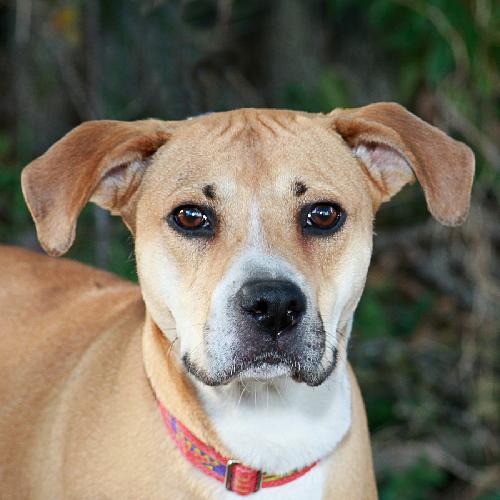
Name: Ruby the Boxer
Status: Adopted!
Adoption Fee: $150
Species: Dog
Breed: Boxer / Labrador Retriever (short coat)
Learn more about the Boxer.Learn more about the Labrador Retriever.
Color: Fawn
Sex: Female (spayed)
Current Size: 45 Pounds
General Potential Size: Medium
Current Age: 18 Years 7 Months (best estimate)
Activity Level: Moderately Active
Indoor or Outdoor: Indoor Only
Good with Dogs: Yes
Good with Kids: No
Housetrained: Yes
Microchipped: Yes
Description:
Ruby was surrendered because she didn't do very well with kids. She is shy at first, but super sweet once she gets to know you. She is also good with other dogs!
1/30/10 Foster Update:
We have spend the first few weeks nursing Ruby back to health from an accident. She was quite shy and cowered when she first arrived at her home. She has adjusted to the routine of our home and seems quite comfortable. She gets along well with our 12 year old 17 pound rescue dog who is part rat terrier and part whippet. He rules the rouse and Ruby allows him to be in charge besides her 40 pound large size. She understands that he is a cranky and does not wish to be bothered. She has a healthy appetite and eats twice a day. When we are out both dogs are crated in separate rooms. Ruby does not seem to mind at all. We give her a kong to play with (one of her favorite toys) next to a tennis or lacrosse ball. We finally got her to sit on command today which was quite a challenge (probably from her accident). She had a warm shower today which she seemed to enjoy along with a blow dry which she seemed to get used to after a few minutes. She loves the large bed we purchased for her which is layered with a comforter and towel. When our aged dog gets in it she goes in his little bed which is quite hilarious to see. We have guests to our home often and she is friendly with them all even my older mother.
02/12: Ruby has proven to be quite a football fan. We had about 12 guests over and was terrific. She stayed most of the evening in her dog bed. She loves to play with one of the kongs and lacrosse ball in the morning after she has gone to the bathroom and through out the day. She cry's to let us know when she has to go to the bathroom. She loves to go outside for walks and is just an all around pleasure. We had our dog trainer Elizabeth Baugh (dog trainer, boarder and show dog) evaluate her yesterday and she said that Ruby is a smart dog who wants to please.
2/23: Ruby has had a good week. She loves to go on walks with our dog. We are working on behavior modification skills when we are outside for times when she sees other people and animals. We have been using her dog food since she still sees the extra food as satisfying. She is sleeping and eating well. She barks to let us know that she has to go to the bathroom or when she is bored and needs some extra attention or play time. We throw a lacrosse ball or kong and she retrieves it and brings it back to us. We are working on releasing on command. Since we have been feeding her in the crate (to avoid fighting with our other rescue dog), she goes into the crate as soon as we call her when we are leaving. The 2 crates are side by side to give each other company. She is a loving, loyal dog. We call her our big boned girl as she still thinks she is a yorkie.
According to www.dogbreedinfo.com, the Boxer's ancestors were two German mastiff type dogs, the Bullenbeiszer and the Barenbeiszer. They were later crossed with the powerful ancestors of the Mastiff and Bulldog. Early on, these dogs were prized for hunting, bull baiting, and for pulling carts. A bit farther down the family tree, Boxer ancestors became cattle dogs, and were used to round up livestock. They were also popular circus and theater dogs because they learned tricks so easily. Breeding was rather indiscriminate until the first Boxer studbook was started in 1904, stabilizing the breed standard. In spite of its German origins, "Boxer" is an English name that suitably describes the dog's punchy fighting style. Though early Boxers may have been quite ferocious, the breed today is a very gentle, loving family companion. Some of the Boxer's talents are watchdogging, guarding, police work, military work, search & rescue, competitive obedience, schutzhund and performing tricks. The Boxer is happy, high-spirited, playful, curious and energetic. Highly intelligent, eager and quick to learn, but can be stubborn and sneaky. The Boxer is a good dog for competitive obedience. Constantly on the move, bonding very closely with the family. Loyal and affectionate, Boxers are known for the way they get along so well with children. A well brought-up and properly socialized Boxer will also get along with his own kind and other household pets. However one Boxer owner reported; their Boxer is best friends with their many barn cats and second dog, but will chase and eat their ducks and other farm birds. The female boxer will often get into fights with other female dogs, trying to display her dominance. If one owns a female boxer and another female dog, they will get along and even play most of the time, however they will most likely fight from time to time. It has been said that the name Boxer came from the way the Boxer likes to use is front paws for just about everything. If you have ever watched a Boxer go about his business you may have noticed the way he paws at his toys, food bowl and you for that matter, in a very playful cat-like way. Some Boxers have been known to paw at their food or water bowl if they are empty. Playfully barking, pawing and playing with the bowl, flipping it upside-down and putting their front paws on the top of the bowl, sliding it around the house barking and whining until someone fills it for them. It looks like a silly game, but the Boxer knows what he is trying to tell you, he's hungry! While participating the sport of schutzhund, Boxers are known to jump up and use their front paws as if they are boxing. They are very clownish and playful and have been known to grab and carry ANYTHING around including your knickknacks if he thinks he can get away with it. The Boxer's nature is to protect you, your family, and your home. Known visitors will be welcomed boisterously. They are always keen to work and play. Boxers need lots of human companionship. They can be rather boisterous and even in old age are still extremely athletic. Teach the Boxer not to be boisterous and especially not to jump up at people. Boxers LOVE to jump. This breed is noted for courage and makes great guard dogs. Boxers have a wide use in military and police work. Training should start young and be firm and consistent. This breed requires a dominant owner. An excellent watchdog, the Boxer will restrain an intruder in the same way a Bulldog does. They have a life expectancy of 11-14 years.
Other Pictures of Ruby the Boxer (click to see larger version):
;) 42.5k |
;) 75.5k |


Copyright © Pet Rescue by Judy